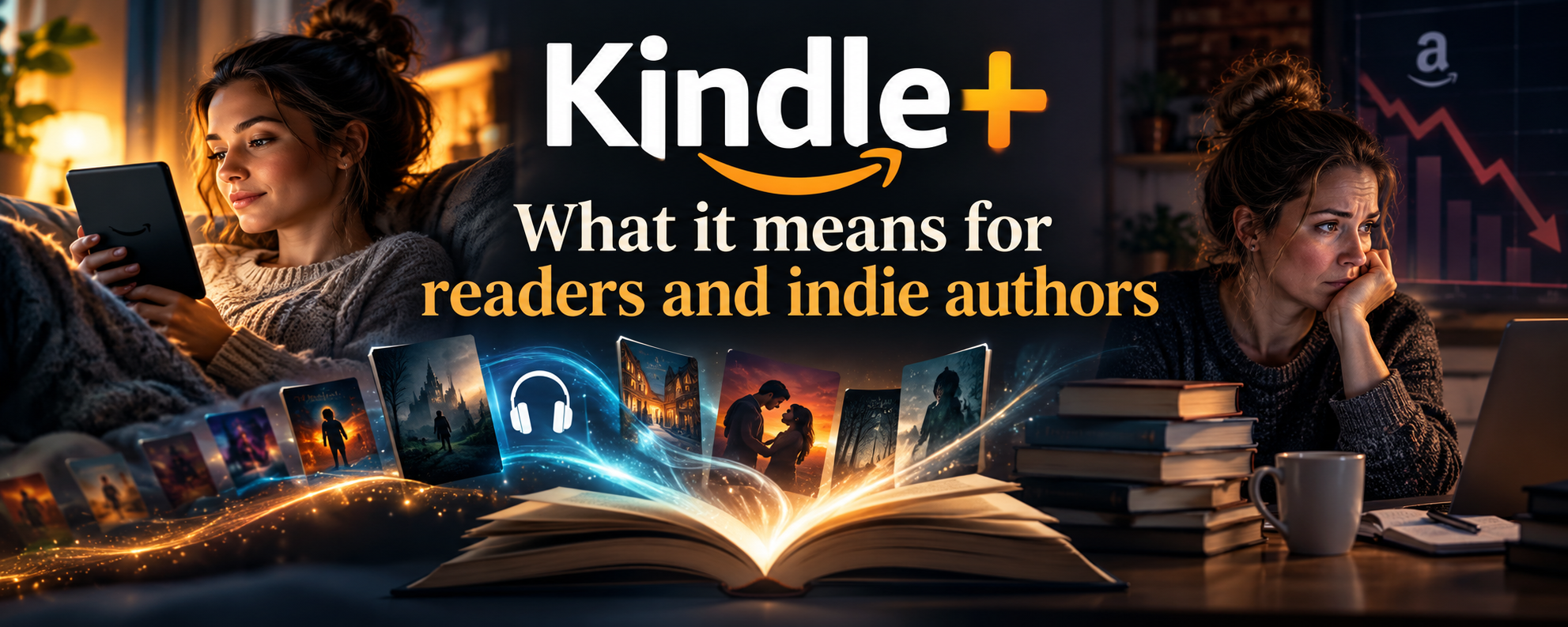
Amazon's new subscription model promises more choice for readers. But for independent authors already struggling with falling sales, is this another step towards a future where books are consumed rather than bought?
Over the last few months, I've watched my Amazon book sales plummet.
Now, I'm no stranger to the ups and downs of independent publishing. I've been writing and publishing long enough to know that sales fluctuate. Some months are good, others are disappointing, and occasionally you find yourself staring at your Kindle Direct Publishing (KDP) dashboard wondering whether anyone is actually seeing your books.
But the decline I've experienced recently has been particularly alarming.
I can't definitively say what has caused it. Amazon regularly changes how its marketplace operates, and authors aren't exactly given a detailed explanation of how its recommendation algorithms work.
However, the arrival of Kindle+ has left me wondering whether things are about to become even more difficult for independent authors who choose to remain outside Amazon's subscription ecosystem.
Because while Kindle+ sounds fantastic for readers, I'm not convinced it will be quite so wonderful for every author.
What exactly is Kindle+?
On 21 October 2026, Amazon announced that Kindle Unlimited was being rebranded as Kindle+, with audiobooks being incorporated into the subscription service.
The basic premise remains familiar. Readers pay a monthly subscription and gain access to a catalogue of books without having to purchase each title individually.
The significant change is the addition of audiobooks, including eligible titles using Amazon's AI-powered virtual narration. Initially, the audiobook offering is available in the United States, with other markets expected to follow.
For subscribers, this is an attractive proposition. Read a book on your Kindle, listen to an audiobook while driving to work, and potentially move between the two formats.
It's convenient, and convenience is something Amazon understands extremely well.
For authors, however, things are rather more complicated.
The problem with the subscription model
To participate in Kindle+, independent authors must enrol eligible titles in KDP Select.
For ebooks, that means agreeing to distribute the digital edition exclusively through Amazon during the 90-day enrolment period.
You can still sell physical copies elsewhere, but you cannot sell the ebook through competing retailers such as Kobo, Apple Books or Google Play.
In return, your book becomes available to Kindle+ subscribers, and you receive royalties based on how much of it people actually read or listen to.
This isn't entirely new. Kindle Unlimited has operated on a similar basis for years.
But expanding the subscription to include audiobooks makes Amazon's ecosystem an even more comprehensive destination for readers.
And therein lies my concern.
What happens to authors who don't want to surrender their independence to participate?
As somebody who publishes independently, I value being able to make decisions about where and how my books are sold. The whole attraction of self-publishing was escaping the restrictions and gatekeepers of traditional publishing.
Yet increasingly, it feels as though we're exchanging one set of gatekeepers for another.
Are readers going to stop buying books?
I don't believe readers will suddenly abandon buying books altogether. People still love physical books, collecting favourite editions and supporting their favourite authors.
But subscription services undeniably change consumer behaviour.
Think about music. How many people regularly purchase individual albums nowadays compared with listening through Spotify or another streaming platform?
The same has happened with films and television.
Why buy something individually when you're already paying for access to thousands of alternatives?
Books are different, of course. Reading requires a greater investment of time and attention than listening to a song. But that doesn't mean the economics of subscriptions won't influence purchasing decisions.
Imagine you're browsing Amazon for your next fantasy novel. You find two interesting books. One is included in your Kindle+ subscription, while the other costs £4.99.
Which are you more likely to choose?
Some readers will happily purchase the second book. Others, understandably, will choose the title they've effectively already paid to access.
Multiply that decision across millions of customers, and you can see why authors outside the subscription programme might be nervous.
There's no public evidence yet that Amazon is deliberately reducing the visibility of books outside Kindle+. But a deliberate algorithmic penalty isn't necessary for subscription titles to gain a commercial advantage.
Reader behaviour alone could produce that effect.
Independent authors were already facing a difficult market
The frustrating thing is that Kindle+ isn't arriving in a particularly healthy environment for many independent authors.
Competition has become relentless. Every year, enormous numbers of new books enter the marketplace, while authors compete for the same limited pool of reader attention.
AI-generated fiction has made that competition even more complicated.
A July 2026 research paper, Generative AI floods and dilutes the market for books, examined 14,419 self-published genre-fiction titles on Amazon between 2023 and 2026.
The researchers found that the number of books recording sales in a quarter increased 19.2-fold during the period studied, while quarterly revenue increased only 8.9-fold.
In other words, the number of books finding buyers grew considerably faster than the money being spent on them.
The study also found that titles identified as containing substantial AI-generated text were gaining a growing share of sales and prominent ranking positions.
Now, I don't want to turn this into another argument about AI writing. But when it's becoming easier to produce books at scale, established authors have to compete with an increasingly crowded marketplace.
Add the costs of advertising and the difficulty of remaining visible, and earning a reasonable return on years of creative effort becomes even harder.
For authors like me, who have invested considerable time in creating entire fantasy worlds and multi-book sagas, that's worrying.
Will Kindle+ actually pay authors fairly?
Amazon says authors participating in Kindle+ will continue to receive a share of the KDP Select Global Fund.
The company reported $69.3 million in total KDP Select author earnings for September 2026.
That's certainly a substantial amount of money.
But the headline figure doesn't tell us how much individual authors are earning.
Under Kindle+, royalties are calculated according to eligible pages read or listened to. Authors aren't guaranteed a fixed payment every time someone downloads a book, and the payment rate can vary from month to month.
There's also an interesting wrinkle with the new audiobook system.
If somebody reads the first fifty pages of your ebook and listens to the next fifty, both portions can contribute towards your royalties.
But if they read those first fifty pages and then listen to exactly the same material, you don't get paid twice.
Amazon is also incorporating eligible AI-narrated audiobooks into the subscription, potentially making audio distribution more accessible to writers who couldn't previously afford professional narration.
That could be beneficial. But it also raises questions about competition for professional narrators and how audiobook production will evolve.
Ultimately, Kindle+ might create additional revenue opportunities for participating authors.
The problem is that none of us knows whether those opportunities will outweigh the potential loss of individual sales, or what happens to authors who remain outside the programme.
The danger of becoming dependent on Amazon
Perhaps my biggest concern isn't Kindle+ itself.
It's how dependent independent publishing has become on one company.
Amazon revolutionised publishing. Without Kindle and KDP, many authors, myself included, would have found it considerably harder to reach readers.
We should acknowledge that.
But Amazon also controls the marketplace, the search results, the recommendation systems, the advertising platform and now an increasingly attractive subscription service.
That's an extraordinary amount of influence over how books are discovered and consumed.
For an independent author, a sudden decline in visibility can be devastating. You might have written a fantastic novel, invested in professional editing, commissioned beautiful cover artwork and spent months promoting it.
Yet if readers cannot find your work, none of that matters.
And the worst part is that you may never know exactly why your sales have fallen.
My own recent experience has made me question how sustainable that situation really is.
I haven't changed the fundamental nature of what I write. My books haven't suddenly become worse. Yet the sales figures have deteriorated.
There are several possible explanations, including competition, changing reader demand, seasonal trends and changes to Amazon's marketplace.
I cannot prove which is responsible.
What I do know is that the lack of transparency makes it extremely difficult for authors to respond intelligently.
What can independent authors do?
I don't think abandoning Amazon altogether is realistic for most of us. It's simply too important a marketplace.
Nor am I suggesting authors should automatically reject Kindle+.
For some writers, particularly those publishing frequently in genres with enthusiastic subscription readerships, it might prove extremely profitable.
But I do think we need to become less dependent on Amazon as our sole route to readers.
That means considering wider distribution through other retailers, developing mailing lists, building direct relationships with readers, and supporting platforms that allow authors greater control over their work.
There are trade-offs. Leaving KDP Select means giving up subscription royalties and certain promotional opportunities. Selling directly also requires time, marketing and customer support.
None of these alternatives offers a guaranteed solution.
Still, having more than one route to your readers strikes me as an increasingly sensible approach.
Readers have more power than they realise
I also want to make something clear to readers: there is absolutely nothing wrong with using Kindle+.
If you read dozens of books every year, a subscription can offer remarkable value. Books should be accessible, and anything that encourages people to read is worth celebrating.
But if you discover an independent author whose work you enjoy, consider supporting them beyond the subscription service.
Buy one of their books. Pick up a paperback. Leave an honest review. Recommend them to a friend. Subscribe to their newsletter.
These things make an enormous difference, particularly to authors who don't have the marketing budgets of major publishers behind them.
A single review or recommendation can help introduce a book to somebody who might otherwise never discover it.
And buying a book directly supports the writer who spent months, sometimes years, creating it.
Is Kindle+ the beginning of another difficult chapter?
Perhaps I'm being overly pessimistic.
Maybe Kindle+ will introduce millions of readers to books and authors they would never otherwise have discovered. Maybe the expanded audiobook offering will create genuinely valuable opportunities for independent writers.
I certainly hope so.
But having watched my sales decline over recent months, I can't help feeling uneasy about another change that could make participating in Amazon's ecosystem increasingly important to commercial success.
I didn't become an independent author to have every aspect of my writing career dictated by a single company.
I became one because I wanted the freedom to tell stories, create worlds and share them with readers on my own terms.
I suspect many other indie authors feel exactly the same.
The question isn't whether Kindle+ will be good for readers. I suspect it probably will be.
The question is whether the future of reading will leave enough room for authors who want to remain genuinely independent.
And that's something all of us who care about books should be paying attention to.
Are you an independent author who has noticed a decline in Amazon sales recently? Or are you a reader planning to subscribe to Kindle+? We'd love to hear your thoughts.