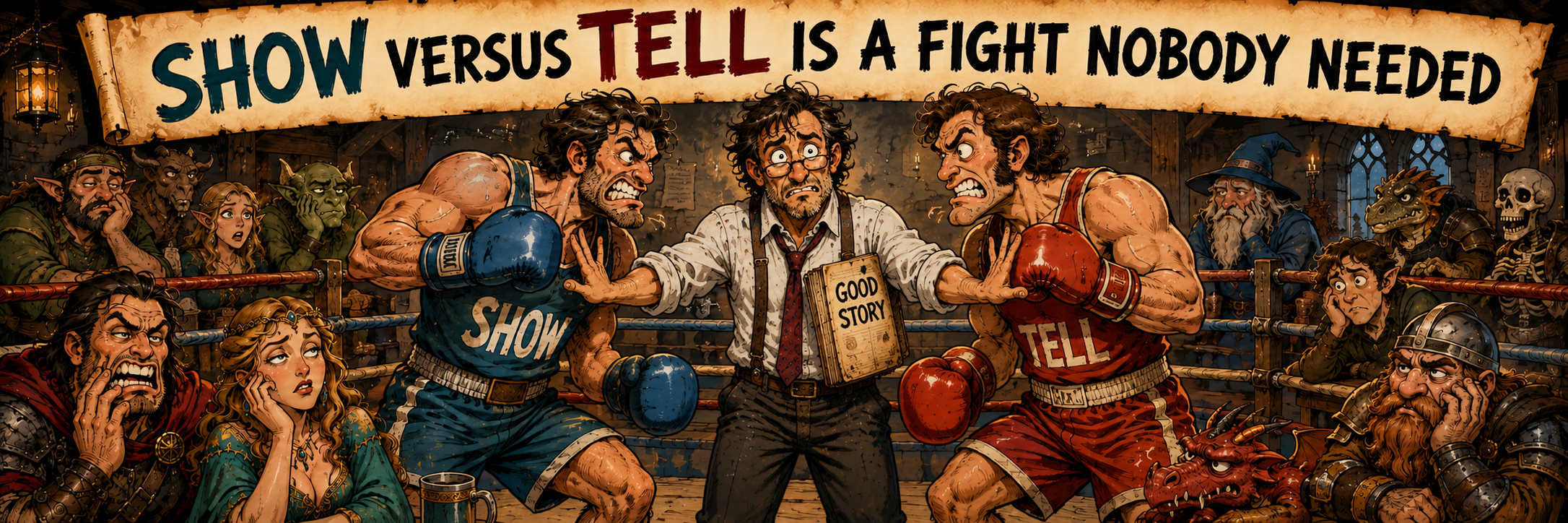
Show, Don’t Tell” is bad writing advice. There, I’ve said it. Woah, woah, before you send abuse and tell me I’m an idiot hold on a moment and hear me out.
“Show, don’t tell” has become something of a sacred rule of modern writing that nobody is allowed to question, along with opening with a hook, murdering all your adverbs and apparently ensuring that every character has an emotional support eyebrow to raise whenever they are sceptical.
It is repeated in writing groups, editing notes, online courses and social media posts as though it were handed down on a stone tablet by Stephen King himself (yuck). Tell the reader something directly and somebody will inevitably materialise in the comments to inform you that you should have shown it instead. They may even provide an example involving a clenched jaw, a pounding heart and a character’s hands knotting into fists. I’ve done all those and still do but hear me out it isn’t the be all of writing.
The implication is always the same: showing is sophisticated, while telling is what bad writers do because they cannot think of an interesting way to describe someone being sad.
I disagree. In fact, I think the modern obsession with “show, don’t tell” is actively making some stories worse. It slows down plots, produces shallow characters and fills books with so much twitching, trembling and breath-catching that half the cast appears to require urgent medical attention.
The best stories do not choose between showing and telling. They use both, because they are tools not immovable rules.
Your characters can just be angry
You will have seen this advice before:
Don’t tell us that John was angry. Show his jaw tightening, his face reddening and his fists clenching.
Fine. That works perfectly well if John is moments away from punching his brother at their mother’s funeral. It is probably less necessary if John is mildly annoyed because someone has parked across his drive.
Not every emotion needs a full dramatic reconstruction.
Sometimes John was just angry. Sometimes Sarah was just frightened. Sometimes Malcolm just thought the meeting was a complete waste of time. A writer should be allowed to say these things without being dragged before an imaginary literary tribunal and sentenced to six months of describing body language.
The problem is not telling the reader that John is angry. The problem is telling them he is angry when the scene would be more powerful if they experienced that anger through what he says and does. Those are not the same thing, and pretending they are has led to a generation of fictional characters grinding their teeth into powder.
Writers now seem terrified of naming emotions. Nobody feels nervous anymore. Their stomach tightens. Their mouth goes dry. Their pulse quickens. A cold sensation moves down their spine. They become acutely aware of the distance between themselves and the nearest exit.
After several chapters of this, I no longer think the character is nervous. I think they have a serious cardiovascular condition.
Body language is not character depth
We are constantly told that showing creates deeper characters because it allows readers to interpret their behaviour. Occasionally, this is true. A character insisting they are fine while quietly removing their wedding ring tells us far more than a paragraph explaining that their marriage is in trouble.
Unfortunately, many writers have taken this to mean that all inner life must be translated into physical movement. The result is a sort of emotional charades in which readers are expected to work out what everyone feels from their posture.
A clenched jaw means anger. Folded arms mean defensiveness. Averted eyes mean shame or dishonesty. A single tear rolls down a cheek because tears in fiction apparently understand the importance of travelling one at a time. This is not necessarily depth. It is often just a collection of familiar signals dressed up as subtlety.
Human beings are far more complicated than their visible reactions. We understand our feelings, misunderstand them, lie to ourselves about them and occasionally recognise that we are behaving like complete idiots while continuing to do so anyway. A man can love his brother and resent him. A woman can grieve for someone she hated. A soldier can do something brave for reasons that are selfish, vain or absurd.
A twitching eyebrow cannot carry all of that weight.
One of the great powers of fiction is that it can take us inside another person’s mind. We are not limited to watching characters from across a room like amateur detectives studying CCTV footage. The author can show us what they remember, what they believe, what they refuse to admit and how they justify the indefensible. You know how?
Yet writers are increasingly encouraged to abandon this advantage because explaining a character’s thoughts is supposedly “telling”. Apparently, readers must infer a lifetime of guilt from the way someone stirs their tea.
Sometimes that works. Sometimes it merely creates cold, emotionally remote characters whose deepest thoughts remain hidden because their author was worried that some smart arse will leave a patronising comment denigrating them and saying “SHOW!”
Nobody wants to watch the entire journey
Showing is slow. Its slowness is what gives important scenes their power.
When we show a moment properly, we enter it. We hear the conversation, notice the surroundings and experience events alongside the character. This is exactly what we want during the murder, the betrayal, the first kiss, the last battle or the horrifying discovery that the supposedly dead villain has already signed a three-book contract.
We do not need it when the hero is travelling to the next village.
A journey that takes three weeks can take one short paragraph. A character can spend several months recovering from an injury without the reader being forced to sit beside the bed for every change of bandage. An army can prepare for war without us attending each planning meeting, supply inspection and disciplinary hearing.
Telling allows stories to move. Without it, novels begin to resemble unedited footage. We see everything that happened, but nobody has made the crucial decision about which parts matter. Every meal becomes a scene. Every journey requires dialogue. Every minor emotion receives three paragraphs of physical symptoms and an elaborate weather metaphor.
Then the writer wonders why the novel is 180,000 words long and the plot still has not come anywhere close to the end.
Pacing depends on selection. The writer slows down for moments of consequence and moves quickly across everything connecting them. If every event receives the same attention, the important scenes stop feeling important. You cannot place the entire book in bold and expect anything to stand out.
Telling is where your voice lives
There is another problem with the campaign against telling: it can remove the author’s personality from the prose.
A narrator should be allowed to tell me things. I rather like being told a story. That is generally why I opened the book.
A good narrative voice can summarise a character, comment on the world, compress years of history or make an observation that changes how we understand everything that follows. It can be funny, bitter, pompous, unreliable or completely wrong. The way a narrator tells us something can reveal as much as the information itself.
This is particularly important in first-person fiction. A character’s interpretation of events is part of their personality. What they choose to explain, excuse or conveniently omit tells us who they are. If we strip away that narration in pursuit of pure showing, we may lose the very voice that makes the book worth reading.
Not every story needs to feel as though the author has left a camera in the room and quietly backed away.
Readers Are Not Sitting an Exam
Readers should be trusted, but that does not mean they should be made to work for every scrap of basic information. There is no prize for reaching page 200 and correctly determining that the protagonist dislikes his father.
Nor is obscurity the same as subtlety. A writer can leave so much unsaid that readers do not become intrigued; they simply stop caring. If I cannot understand what a character is thinking, wants, fears or believes, I am not necessarily going to applaud the author’s restraint. I may conclude that the character has all the emotional complexity of a piece of wood.
Naming a feeling does not automatically remove its depth. We’re all human which means we all know what these feelings and emotion feel like. You don’t have to show it for a reader to get it. If I simply tell you that a character is jealous, there are still plenty of interesting questions left. Does he recognise the jealousy? Is he ashamed of it? Is it justified? Will he act on it? Is he about to ruin several lives while insisting that he is behaving perfectly reasonably?
The best writing cheats constantly
The truth is that most good scenes combine showing and telling. We simply pretend otherwise because “use whichever technique best serves the story” does not fit neatly on a motivational graphic.
A writer might tell us that two brothers have resented each other for twenty years, then show the argument that finally tears the family apart. They might summarise months of a friendship before lingering over the moment of betrayal. They might show a woman making tea after receiving terrible news, then tell us that she is concentrating on each familiar movement because she is terrified of what will happen if she stops.
The summary gives the scene context. The scene makes the context matter.
The Rule Is the Problem
“Show, don’t tell” probably began as sensible advice for writers who summarised scenes that deserved to be dramatised. If the emotional heart of your novel is a daughter confronting the mother who abandoned her, then “they argued and eventually reconciled” is unlikely to satisfy anyone. We need to witness that encounter.
But useful advice became a commandment, and commandments are dangerous things to give writers. They encourage us to stop thinking about what a story needs and start worrying about whether we are obeying the approved method.
That is how tools become rules and rules become dogma.
The real question is not whether a passage shows or tells. It is whether it works. Does the reader need to experience this moment or merely understand that it happened? Does the scene need greater emotional force, or does the story need to move on? Would more detail add meaning, or would it add another paragraph about someone’s pulse?
Show the moments that deserve to live on the page. Tell the reader what they need to understand. Summarise the boring journey. Explain the relevant history. Enter the character’s thoughts when those thoughts reveal something action cannot. Slow down for the decisions, confrontations and consequences that change the story.
Most importantly, ignore anyone who treats one technique as morally superior to the other.
“Show, don’t tell” is not a law. It is barely even a rule. At best, it is a reminder that some moments become more powerful when they are dramatised. At worst, it encourages bloated novels filled with shallow characters who spend several hundred pages clenching their jaws at one another.
Perhaps we should replace it with something more honest:
Show when showing makes the story better. Tell when telling makes the story better.
And if anyone objects, narrow your eyes, tighten your jaw and allow one perfectly formed tear to roll slowly down your cheek.