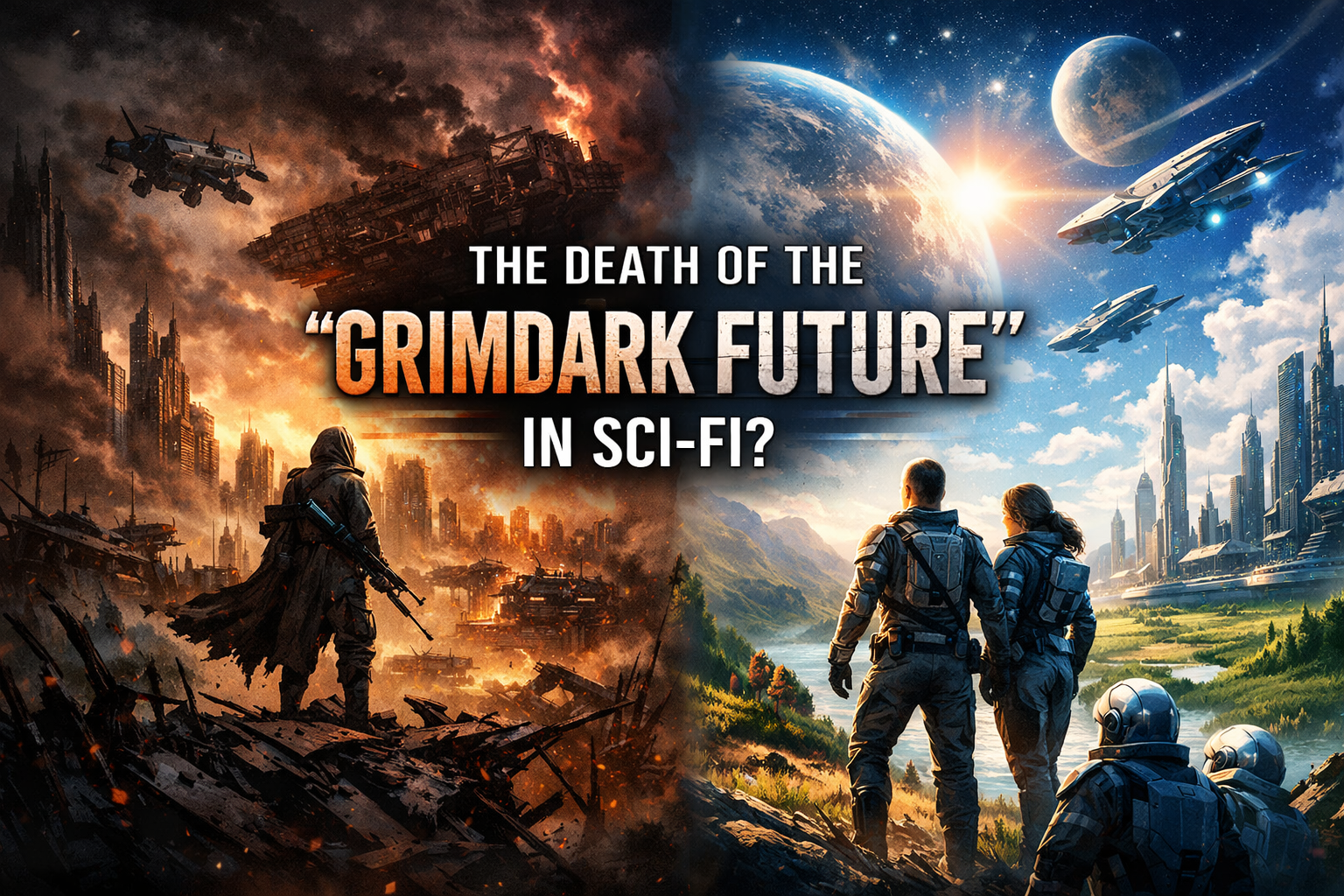
For the better part of two decades, sci-fi has been dominated by bleakness with a few rare bright spots of optimism. Oppressive regimes, collapsing civilisations, morally compromised protagonists, and endings that offer little more than survival. From the rise of dystopian fiction in the 2000s through to the darker tone of modern streaming adaptations, the “grimdark future” has felt less like a trend and more like a default setting. Even modern Star Trek went down the dark future route undoing all the opitmism of the Next Generation era shows.
But that may be changing.
There is a growing shift in both indie and mainstream sci-fi towards something that feels noticeably different. Not naïve optimism, but a return to stories where hope, heroism, and forward momentum actually matter. Readers are beginning to push back against relentless cynicism, and the data, both anecdotal and commercial, suggests they are gravitating towards stories that offer something more than despair. Project Hail Mary’s success at the box office shows that people want a positive depiction of the future where alien contact doesn’t result in death and destruction but friendship and cooperation.
Part of this shift is cultural fatigue. Audiences have spent years consuming narratives where institutions are corrupt, heroes fail, and the future is something to fear. Layer on top real-world uncertainty, economic pressure, geopolitical tensions, and rapid technological change, and it becomes clear why readers might not want their escapism to mirror their anxieties. Sci-fi has always been a lens through which we process the future, but increasingly, readers are looking for stories that offer direction rather than just reflection and depression.
Indie sci-fi has been particularly quick to respond. Without the inertia of traditional publishing cycles, independent authors can pivot faster, experimenting with tone and structure. What we are seeing is a resurgence of space opera and adventure-driven narratives that lean into scale, discovery, and clear stakes. These stories still acknowledge danger and complexity, but they are not defined by nihilism. The difference is subtle but important. Conflict exists, but it is there to be overcome, not to reinforce inevitability.
This does not mean grimdark is disappearing entirely. There will always be a place for darker storytelling, particularly when it is executed with purpose rather than as aesthetic shorthand. The issue is that, for a time, grimdark became a crutch. Darkness was often mistaken for depth, and moral ambiguity became a substitute for meaningful character development. Readers are becoming more discerning. They are not rejecting complexity, but they are rejecting emptiness.
What is replacing it is a recalibration. Stories that balance realism with aspiration. Protagonists who struggle, but ultimately act with intent. Futures that are dangerous, but not devoid of possibility. This is where modern sci-fi has the most room to evolve. Not by abandoning stakes, but by reintroducing meaning.
There is also a structural advantage to this shift. Hopeful or forward-looking sci-fi tends to lend itself better to long-form storytelling. Series benefit from momentum, from the sense that each instalment builds towards something rather than simply revealing further layers of decay. For indie authors especially, this is critical. Read-through is driven not just by plot, but by emotional investment in the trajectory of the world and its characters.
In that sense, the decline of grimdark is less about rejection and more about correction. Sci-fi is rediscovering one of its core functions: to imagine futures worth striving for, not just ones worth surviving. The recent Artemus 2 moon mission has inspired a new generation to be optimisitic over space and the potential glorious future it can bring.
The question is not whether grimdark will vanish. It won’t. The real question is whether it will remain dominant. Right now, all signs suggest its grip is loosening, and in its place, a more balanced, and arguably more powerful, vision of the future is taking hold.