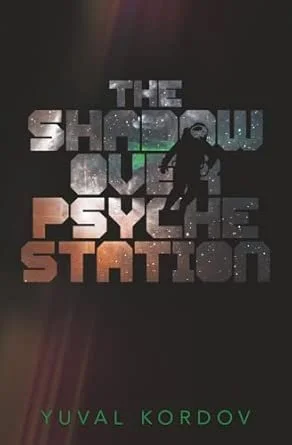
Yuval Kordov’s The Shadow Over Psyche Station is one of those science fiction novels that doesn’t just tell a story, it seeps into you and lingers in the mind long after you’ve put it down, not through spectacle or action, but through a slow, deliberate tightening of tension that feels almost unbearable but results in you being unable to put it down.
At its core, this is a story about observation. Marcus, an Imperial assessor tasked with auditing a distant mining station, is a man trained to measure, to verify, to impose order on systems. But Psyche Station resists definition from the moment he arrives. It’s not simply that something is wrong. It’s that nothing behaves in a way that can be cleanly explained. Systems function, yet feel off. Spaces are intact, yet carry a sense of absence. People, or what should be people, are missing in ways that feel intentional rather than accidental.
What makes Kordov’s approach stand out is how he weaponises ambiguity. Rather than delivering clear horror beats, he builds a layered sense of unease where every answer only deepens the mystery. You begin to question not just the station, but Marcus himself. His physical fragility, his reliance on chemical aids, and his quiet ambition create a protagonist who feels grounded and believable, yet increasingly unreliable. That tension between competence and vulnerability is where much of the novel’s power lies.
The setting is equally compelling. The Empire Marcus serves and its reliance on distant resource extraction give the story a strong hard sci-fi foundation, but Kordov overlays it with something far more abstract and unsettling. Space itself becomes more than a backdrop. It feels vast, indifferent, and quietly invasive. It’s a cosmic horror. The titular station, orbiting the mineral-rich asteroid 16 Psyche, becomes a liminal space between the known and the incomprehensible.
Stylistically, Kordov’s prose is as usual exceptional. There’s a measured, almost ritualistic quality to his writing that mirrors the themes of the novel. He allows scenes to breathe, trusting the reader to sit in the discomfort rather than rushing to resolution. This restraint pays off. By the time the horror fully emerges, it feels earned, not forced. The transition from curiosity to dread to outright terror is handled with remarkable control.
One of the more distinctive elements is the novel’s spiritual undercurrent. There’s a constant interplay between faith, duty, and the unknown. The presence of figures like Father James introduces a fragile counterbalance to the encroaching darkness, offering moments of clarity without ever fully dispelling the threat. It adds a philosophical layer that elevates the narrative beyond standard genre conventions.
Importantly, the novel never loses sight of its human element. Marcus is not a traditional hero. He’s an everyman trying to do his job, earn recognition, and survive an assignment that quickly spirals beyond comprehension. That grounded perspective makes the unfolding horror far more effective. You’re not watching a larger-than-life figure confront the void. You’re watching someone like yourself try to make sense of it, and fail. And when that horror reveals itself, well, I don’t want to spoil anything but it certainly is a WTF moment.
Kordov understands exactly how much to reveal, and when. The result is a story that feels cohesive, immersive, and deeply unsettling without ever becoming chaotic or indulgent.
For readers of cosmic horror, particularly those who appreciate the influence of The Shadow over Innsmouth and the broader works of H. P. Lovecraft, this is essential reading. But even beyond that niche, The Shadow Over Psyche Station stands as a masterclass in atmosphere and restraint.
It’s not just a journey into deep space. It’s a descent into something far quieter, far more insidious, and far harder to escape and this would make an excellent sci-fi horror movie.