Book Review: Gearteeth by Timothy Black
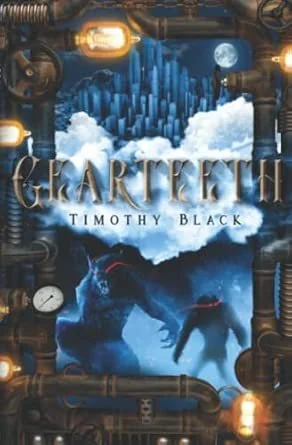
Gearteeth, the first instalment of Timothy Black’s trilogy, was originally published in 2012, with the second book following much later in 2023. I came to this novel without prior knowledge of its publication history or its continuation, drawn primarily by its Goodreads classification as steampunk/fantasy - two elements that piqued my curiosity. While I was broadly familiar with the genre, my personal experience with steampunk has been limited, extending little beyond themed events such as Whitby’s Steampunk Weekend and the aesthetic influences seen in games like Steam Donkey. As such, I approached the novel with interest, but without firm expectations.
The premise is immediately compelling. Set around the turn of the twentieth century, the story imagines a world ravaged by a disease that transforms humans into ravenous werewolves. As civilisation collapses, Nikola Tesla and a secretive group of scientists known as the Tellurians devise a desperate solution: vast floating cities, constructed of iron and steel, designed to lift the uninfected above the chaos below. Humanity retreats to the skies, waiting for the infected to destroy one another.
The narrative is told from the first-person perspective of Elijah Kelly, a brakeman aboard one of the cities’ immense Thunder Trains. His life is thrown into turmoil when a werewolf breaches the safety of the floating city, setting off a chain of events that drives the plot forward.
The concept of mobile or elevated cities immediately brought to mind Mortal Engines by Philip Reeve—a comparison that helped me visualise the setting and eased my entry into a genre I am less familiar with. Black’s world-building is effective from the outset, establishing a strong steampunk aesthetic as we follow Eli and his colleague Henry carrying out repairs before disaster strikes. The opening chapters are fast-paced and engaging, providing a strong introduction to both the setting and the central characters.
However, after this promising start, the pacing becomes uneven. The narrative occasionally slows considerably due to extended technical explanations surrounding the operation of the “Double-T” systems and the electrical infrastructure that powers the city. While readers with an interest in engineering or steampunk mechanics may appreciate this level of detail, I found these sections somewhat dense and disruptive to the story’s momentum. Similarly, while moments of heightened tension—particularly those involving the investigation into the werewolves—reinvigorate the narrative, they are sometimes followed by slower, more analytical passages, such as detailed examinations of a doctor’s journal.
It is also worth noting that the novel explores some darker themes that may require content awareness for certain readers. Elements of the story touch on racial tensions within the context of the doctor’s experiments, and while handled with care, they may still prove uncomfortable for some. Additionally, once Eli leaves the relative safety of the city, the narrative adopts a more brutal tone, with depictions of torture and mutilation, including references involving children. While these aspects serve the story’s grim atmosphere, they may not appeal to all audiences.
Despite these issues, the novel remains an engaging read overall. Black’s prose is clear and accessible, though at times weighed down by dense internal monologue. Nevertheless, the strength of the central premise and the more dynamic sequences sustain interest through the slower sections.
In summary, Gearteeth offers strong world-building and a vivid depiction of life within its floating cities, successfully conveying both the technological intricacies and the harsh realities of this imagined world. The action sequences are well-executed and compelling, encouraging the reader to continue. While the pacing could benefit from tighter editing and some reduction in overly detailed passages, the story itself is imaginative and well-told. I finished the novel having thoroughly enjoyed it and look forward to continuing the series.