Book Review: Blades Reforged by P.J. Ashton
I was asked to review this novel for IBOR; the views are my own and not those of the Epic Indie Team as a whole.
Blades Forged is labelled as Grimdark. As a reader and writer of YA Fantasy, I approached this novel blissfully unaware of what I was letting myself in for. It sent me spinning through all kinds of emotion: revulsion, hate, confusion, joy, laughter, awe, amazement—and boredom. To say I experienced highs and lows while reading would be an understatement. However, I did make it all the way to the end. It’s not unusual for me to abandon a book midway if I really don’t connect with it, so that should go some way to explaining my mixed feelings.
Let’s talk about the book itself first. It follows the fortunes of a number of characters, taking their POVs in alternating chapters. Each has a backstory of woe, loss, and pain. Their lives are grim and dark, and their actions mirror this. We follow Darrow, Captain of the Mudline, and his band of misfit soldiers tasked with carrying out the Emperor’s dirtiest missions—jobs beyond regular conscripts. They are made up of murderers, assassins, crazed priests, and a woman of disrepute . No job is too low for this lot, and they are highly efficient in their brutalisation.
Among them is Henna, a woman who has suffered her fair share of abuse at the hands of men. She now takes out that abuse on the Emperor’s enemies, taking their genitalia as trophies in the process.
Not all the characters we follow are this low. We also follow commoners such as Jenni of the Hops and Mirrelle. While not cold-blooded killers, they too must sink to depravity in order to survive. Then there is Queen Elecia. She lives above the filth, blood, and chaos, smoothing her way through the upper circles of society, yet with no less thirst for conquest and victory than the others.
All in all, the cast of characters is varied and interesting. I want to say they are unpleasant, but that isn’t true. I actually found them all engaging, despite the level of violence and sexual gratuity that seems to shadow them on every page.
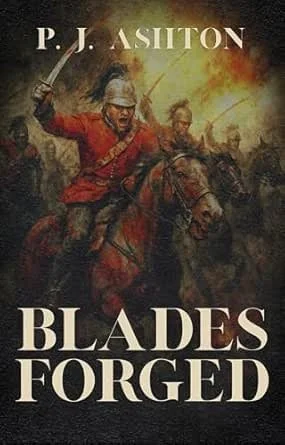
The world appears to be based loosely on a Napoleonic-style landscape, with our protagonists deep in the middle of a bloody war between two rival nations. The concept has a strong Sharpe feel to it, and I would guess the author has drawn heavily on military history. Some engagements closely reminded me of incidents I’ve read about from the Battle of Waterloo. This isn’t traditional fantasy, despite being set in a world not our own. Magic is touched upon only briefly: one character encounters a group who can change their appearance and hide among normal folk, and we also get hints that the gods sometimes take over normal citizens to experience life and guide them toward deeds they might not otherwise commit. These ideas are only lightly explored here, so perhaps more will be revealed in later novels.
On to the review itself. This is, as I’ve said, Grimdark—and I was not fully prepared for what I was about to read. To put it in terms the book would appreciate: the first chapter forces you to your knees, grinds your face into the crotch of a downtrodden infantryman, and expects you to swallow without complaint. Foul language is constant, the violence graphic, with rape and genital mutilation recurring themes. Sexual references appear on almost every page.
That said, once I became numb to the excess, I did begin to enjoy parts of the story. Some of the lines are grimly funny, occasionally laugh-out-loud so. One comparison in particular (I desperately wanted to quote it here but erred on caution) stood out as both shocking and darkly amusing. Grim, yes—but effective.
I found the prose challenging. Each POV is written in a distinct style, but for me this made reading a chore rather than a pleasure. Imagine Sean Bean reading Shakespeare with his Yorkshire accent turned up to full. I’m from Yorkshire myself, yet I still found I had to slow down and mentally “perform” the dialogue to make sense of it.
Queen Elecia’s chapters swing in the opposite direction, with flowery, dense prose that had me pausing frequently to interpret meaning before moving on.
Don’t get me wrong—this is clever, clearly intentional, and impressively executed. The effort Ashton has put into the craft is undeniable. Some readers will love the layered prose and hidden meanings. Personally, I found that after a few chapters it became tedious. I want my eyes to flow over the page and sink into the story, not feel like I need a student’s guide to Shakespeare to keep up.
The final point is the story itself. This is a long book, and while individual scenes are often engaging, there is little sense of an overarching narrative driving things forward. The battle scenes are particularly strong, and you genuinely feel how grim and unforgiving life is, but I struggled to identify a clear story arc.
It’s possible I missed it, or that it will be developed further in later books. This feels very much like a character-driven novel: get to know the cast first, and push the larger story along later.
Overall verdict: this is a powerful piece of work. It’s very well written, clever, and polished. The language is dark, as expected, and pulls no punches—children should stay well away. Personally, it wasn’t to my taste. I enjoyed certain sections, but overall I found struggling through the cut-off prose hard work, which made reading less enjoyable. I’m certain that in the right hands this book will be among many people’s favourites. It just wasn’t mine.