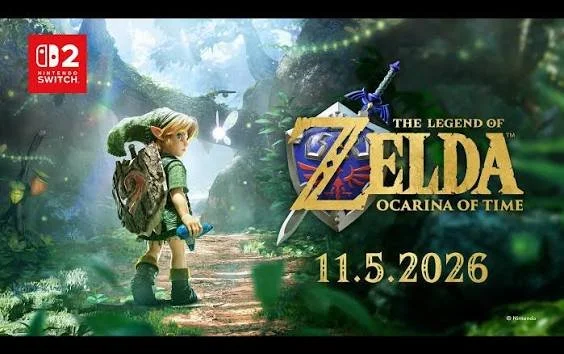
Nearly three decades after redefining adventure games, Nintendo has brought one of gaming's greatest achievements back to life. But can a remake ever recapture the magic of experiencing Hyrule for the very first time?
I was 12 years old when I first stepped into the world of Hyrule on my Nintendo 64, and I don't think it's an exaggeration to say that The Legend of Zelda: Ocarina of Time changed how I looked at video games and not to be too over the top, life forever.
Back in 1998, gaming was a very different beast. The transition to 3D was still relatively new, and developers were only beginning to understand the possibilities it offered. Then along came Ocarina of Time, a game that made everything else seem positively prehistoric.
I can still remember the excitement of leaving Kokiri Forest for the first time and stepping out into Hyrule Field. The sheer scale of it blew my young mind. There was an entire world waiting to be explored, full of strange characters, dangerous monsters, mysterious temples and secrets waiting to be uncovered. It felt like a genuine adventure, one where anything might be possible.
I spent countless hours exploring every corner of Hyrule, getting hopelessly lost in dungeons, battling monsters and trying to work out what on earth I was supposed to do next. There was no internet guide readily available to point me in the right direction, and that was part of the magic. Every discovery felt earned, every boss defeated was a triumph, and every new piece of music became permanently embedded in my memory.
For that 12-year-old boy, Ocarina of Time wasn't simply another video game. It was the greatest adventure I'd ever experienced and it only solidified my love of the fantasy genre.
Twenty-eight years later, Nintendo has finally given this legendary game the full remake treatment on the Switch 2. As someone who holds the original in such high regard, I approached it with both excitement and trepidation. After all, how do you improve upon something that many, myself included, consider practically perfect?
Well, as it turns out, quite brilliantly.
Hyrule has never looked better
The first thing that strikes you about the remake is just how spectacular it looks. Nintendo hasn't simply slapped some higher-resolution textures onto the original and called it a day. This is a complete visual overhaul, one that brings Hyrule into the modern era without sacrificing the distinctive art direction that made the original so memorable.
Kokiri Forest is now a lush, vibrant woodland teeming with detail. Hyrule Field feels like a proper landscape, with rolling hills, gorgeous lighting and distant landmarks that practically beg to be explored. Castle Town is bursting with character, while locations such as Zora's Domain and Death Mountain look better than I could ever have imagined back in 1998.
Perhaps most impressive is how Nintendo has preserved the atmosphere of the original. Ocarina of Time was never entirely a cheerful fantasy adventure. Beneath its colourful presentation lay a surprisingly dark world, particularly once Link awakens as an adult to discover what Ganondorf has done to Hyrule.
The remake understands this perfectly. The ruined version of Castle Town is genuinely unsettling, while the darker dungeons retain their sense of dread. The improved lighting and environmental detail make these locations even more atmospheric.
It's the sort of visual upgrade that makes you stop playing simply to admire your surroundings. More than once, I found myself looking around locations I had visited hundreds of times before, almost unable to believe how beautiful they had become.
A soundtrack worthy of a legend
If the graphics are spectacular, the music is something else entirely.
Koji Kondo's original soundtrack is one of the greatest in gaming history, featuring melodies that have become synonymous with the Zelda franchise. From the instantly recognisable theme of Hyrule Field to the haunting music of the Temple of Time, practically every composition is a classic.
The remake takes these beloved pieces and gives them the orchestral treatment they deserve. The result is magnificent.
Hearing familiar melodies performed with such richness and depth is an emotional experience, particularly for those of us who grew up with the original. The music of Kokiri Forest immediately transports you back to childhood, while the more dramatic compositions now possess a cinematic grandeur that perfectly complements the upgraded visuals.
Importantly, the new arrangements never lose sight of what made the originals special. Nintendo has resisted the temptation to needlessly reinvent them, instead enhancing their emotional impact.
Put simply, this is one of the finest soundtracks I've heard in a video game for years. Playing with a decent pair of headphones or a proper sound system is highly recommended.
Familiar faces with newfound personality
One of the more welcome improvements comes in the storytelling and characterisation.
While Ocarina of Time featured a fantastic narrative for its day, the limitations of the Nintendo 64 meant that much of the character development relied on relatively basic animations and text boxes. The remake addresses this through more expressive characters, improved dialogue, additional cutscenes and voice acting.
Princess Zelda feels like a more rounded character, with greater emotional weight behind her decisions, while Ganondorf is every bit the imposing villain he should be. Supporting characters also benefit enormously from the added personality, making Hyrule feel like a world populated by actual people rather than NPCs waiting to deliver their next line.
What I particularly appreciate is that Nintendo hasn't attempted to fundamentally rewrite the story. The central themes of courage, friendship, sacrifice and the passage of time remain intact.
Indeed, revisiting the narrative as an adult gives it an entirely different emotional dimension. The story of a young boy who has his childhood taken away from him, only to awaken in a world that has changed beyond recognition, hits rather differently when you're no longer 12 yourself.
There is a sadness running through Ocarina of Time that I perhaps didn't fully appreciate as a child. The remake's stronger presentation brings this to the forefront, making an already excellent story even more affecting.
Combat that packs a punch
Perhaps the most immediately satisfying gameplay improvement is the combat.
The original Ocarina of Time was revolutionary for introducing Z-targeting, a mechanic that would influence countless action-adventure games over the following decades. However, returning to the Nintendo 64 version today reveals just how much action combat has evolved since then.
Thankfully, the remake feels considerably more responsive and satisfying.
Link moves with greater fluidity, his attacks carry genuine weight, and the improved animations make every sword strike feel impactful. There's a real sense of physicality to combat that simply wasn't possible in the original.
Fighting Stalfos, Lizalfos and other familiar enemies is now a genuinely meaty experience. Sword clashes look and sound fantastic, defensive manoeuvres feel more natural, and landing that final blow delivers an immensely satisfying sense of accomplishment.
Boss battles also benefit from the improved presentation. Encounters that were already memorable in 1998 now feel suitably epic, thanks to their dramatic animations, imposing visuals and fantastic musical accompaniment.
Crucially, Nintendo hasn't turned Link into some unstoppable action hero. Combat remains recognisably Zelda, with an emphasis on timing, positioning and understanding enemy behaviour rather than simply mashing buttons.
It's a careful balance, and one that the developers have largely nailed.
Has Nintendo made things a little too easy?
For all my praise, the remake isn't without its frustrations, and my biggest criticism concerns the way Nintendo has approached some of the original's puzzles.
One of the things that made Ocarina of Time so rewarding was its willingness to let players figure things out for themselves. Some of its dungeons were genuinely challenging, requiring careful observation, experimentation and occasionally a considerable amount of patience.
The remake, unfortunately, seems a little reluctant to allow players to struggle.
Certain puzzles have been simplified, while improved visual cues and quest guidance sometimes make solutions considerably more obvious than they were in the original. In isolation, many of these changes are perfectly reasonable, particularly for newcomers who might otherwise find themselves stuck.
However, there are occasions when the game feels unnecessarily hand-holdy, almost as though Nintendo is worried that players might become frustrated if they aren't constantly nudged in the right direction.
The Water Temple is perhaps the most obvious example. Infamous for its confusing layout and tedious equipment management in the original, it has received several welcome quality-of-life improvements. Switching equipment is much easier, and navigating the dungeon is considerably less frustrating.
Those are good changes. Yet there's a distinction between removing unnecessary inconvenience and removing the satisfaction of solving a difficult puzzle.
At times, the remake edges a little too close to the latter.
Part of what made the original so special was that sense of achievement when you finally cracked a puzzle that had been driving you mad for hours. Modern games seem increasingly afraid of allowing players to experience that kind of frustration, even when overcoming it is precisely what makes the eventual success so rewarding.
I would have liked Nintendo to offer an option to reduce the hints and guidance, allowing experienced players to tackle Hyrule's dungeons with something closer to the original level of challenge.
It's not a dealbreaker, but it does occasionally diminish the sense of discovery that made the Nintendo 64 adventure so remarkable.
A reminder of why Zelda became legendary
Something that struck me while playing the remake is just how well Ocarina of Time's fundamental design has aged.
Modern Zelda titles such as Breath of the Wild and Tears of the Kingdom have embraced enormous open worlds and unprecedented player freedom. They're excellent games in their own right, but returning to the more structured adventure of Ocarina of Time reminded me why I fell in love with the series in the first place.
There's something deeply satisfying about its carefully crafted progression. Every dungeon introduces new challenges, every important item opens fresh possibilities, and every major story beat pushes the adventure towards its unforgettable conclusion.
Nothing feels particularly wasted or unnecessary. Hyrule might not be the largest game world by modern standards, but it remains one of the most memorable.
The remake also benefits from numerous modern conveniences, including improved camera controls, more intuitive equipment management and better navigation. These refinements eliminate many of the annoyances associated with older 3D games without fundamentally changing what makes the experience work.
And that's perhaps Nintendo's greatest achievement here. Rather than attempting to reinvent Ocarina of Time, the developers have recognised that the original design was already exceptional. It simply needed the technology and thoughtful refinements to allow a new generation to appreciate it.
Overall it is a spectacular remake of one of the greatest games ever made.
Pros
Stunning graphical overhaul
Magnificent orchestral soundtrack
Improved characters and storytelling
Meaty, satisfying combat
Preserves the original's magic
Cons
Some puzzles feel dumbed down
Too much hand-holding
Veterans may find the challenge lacking