Throughout history storytelling has been known for exaggerations and partial truths about the legends who came before us. Whether it’s Beowulf and his claims of his deeds or the tales of legends like Arthur or Achilles whose legends were shaped over time, growing with every retelling. In the world of fiction this stretching of the laws of reality has become a regular thing that’s generally accepted.
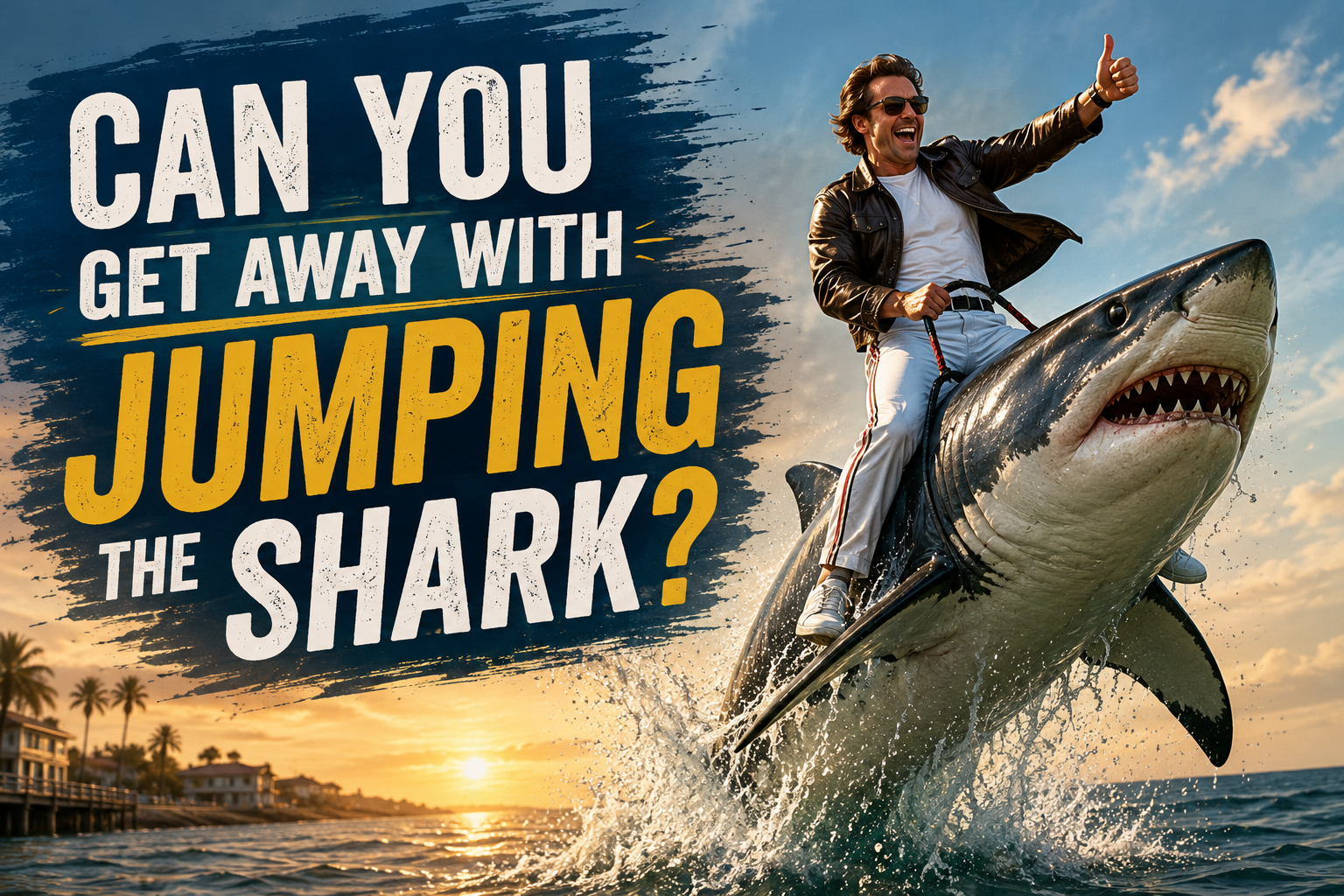
But sometimes authors can take this too far, changing the story from a simple plot expansion to a run away tale that is hard to grasp for the reader. This action has potentially saved franchises, but it’s been a death nail for others. In Hollywood they have a term for this, it’s called “Jumping the Shark”.
This term comes from the show “Happy Days” when in an attempt to save collapsing ratings the show decided to have one of the fan favorite characters, Fonzie, water ski over a jump surrounded by live sharks. This was an attempt to potentially attract fans of the recent blockbuster hit, Jaws. “Happy Days” did end up going on for another six seasons after this, but the ratings continued a gradual decline during all of those seasons, so we can’t say for sure if it worked.
We see this in the book world as well in one of two different circumstances. The most common we see is in a longer series where an author is trying to keep the escalating tension of the series, but takes it too far. The second I see frequently is similar to why it is done in “Happy Days”. Authors will use it as an attempted lure, they’ll bring in a powerful being and hint at it in their blurbs and on social media. They make that moment the foundation the book is built around in the public eye.
As I said earlier, I’ve seen both of these work really well and I’ve seen this kill a series for readers. For example, the escalating action jump where an author brings in a new bad guy who is way more powerful then the main one or jumps the need from save this town to save the planet. These extreme jumps can work, if you’ve planned for this and placed foreshadowing throughout the earlier books or if your writing style is flamboyant and prone to off the wall jumps.
A great example of this working is the series “Expeditionary Force”. Craig Alanson has a writing style where random twists and extreme jumps are what you expect from him. He also laces hints at these potential jumps throughout the earlier books so it feels more like a wild twist instead of throwing you out of the story. To learn more about this series, you can check out my review on this site.
As far as the other means of Jumping The Shark as an author is a lot harder to find a good example of. These very quickly become cheesy and keep people from getting into the story from early on. The best example of this shows up in video games like “God of War” where they bring in known mythological beings to draw in players.
I’m sure most readers can think of at least one book that they’ve read where something happened that was so extreme that it made them stop and roll their eyes. As authors, this is our worst nightmare. Anything that pulls a reader out of your story risks losing a reader and that means more than just one reader's worth of lost income.
So how do we as authors decide when to jump the shark in our stories? There are a few easy indicators to help you know quickly if it’s a good idea. If you check for those first, you’ll be in a good position to save yourself from the pain of this going wrong.
The first check is a simple one. Does what you want to do violate any of the rules of the genre in which you’re writing? If you’re adding telepathic Aliens to a hard Sci-fi, or a comically powerful villain to a grim dark novel you’re doing something wrong. Every genre has the “Thou Shalt Not” rules that are a 99% chance that you’ll kick your readers out of the story or worse. This may seem tempting to do something that will stand out but very few authors, including those who sit at the very top of the Times Best Sellers list, can pull it off.
The second check is another simple one as the author of the story. Is this something that’s plausible in the story you wrote? If you’ve hinted at this throughout the story and it matches the natural progression of your plot, a big plot point won’t throw out your reader. It will instead pull them deeper with the twist. But if it doesn’t flow well with the plot, you will bounce the reader out harder than most other writer mistakes.
If you pass these two tests, the last one is simple. Run it past someone in your writing group or a fan of the genre. Getting a second opinion will drastically increase your success if you decide to pull the trigger. At that point, hit the ramp and jump the shark.