Book Review: The Worlds of Origin by Dan D. Becheru
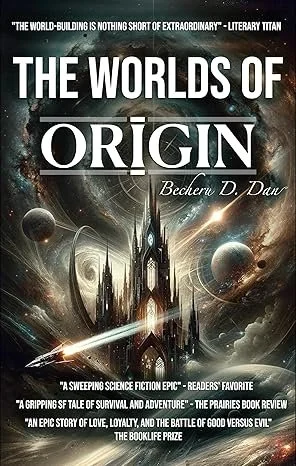
The Worlds of Origin by Dan D. Becheru is undeniably ambitious, an expansive, millennium-spanning work that blends science fiction, fantasy, cosmic prophecy, and interstellar intrigue. The premise is immediately compelling: a galaxy where faster-than-light travel is controlled by a secretive order, a looming prophecy threatens all life, and a single ship embarks on a mission that may determine the fate of everything. Becheru’s imagination is vast, and it’s clear from the outset that this novel aims to deliver an epic, lore-rich experience.
There is much here that will appeal to readers who enjoy large-scale world-building. The ancient origins of the Galaxy’s empires, and the threads that connect events across 900,000 years, form a setting that feels enormous and full of potential. The book introduces hidden agents working against the crew, enigmatic Black Ships, and a prophecy known as the Desolation, which gives the sense of a universe shaped by forces far beyond immediate comprehension. There are moments where the scope feels genuinely awe-inspiring.
That said, the execution didn’t fully work for me, though I can see how it may strongly appeal to others. My main difficulty lay in the structure of the narrative. Very early on, the story shifts rapidly between numerous perspectives. Six or more by the first ten chapters, and I struggled to understand who the central protagonist was supposed to be. While multiple points of view can enrich a complex setting, the transitions here felt abrupt, and by around 150 pages in, I still didn’t feel grounded in any one character’s arc or motivations. This made it hard to emotionally connect with the story or form attachments to the people involved.
The book also alternates between third-person narration and sudden first-person chapters; these shifts occur without clear context or indication of whose perspective the reader is entering, which added to my confusion.
Additionally, I encountered a significant number of spelling and grammatical errors. Other reviewers have noted this as well, and unfortunately, I found it distracting. Errors on their own don’t diminish a good story, but when they occur frequently, they interrupt the flow and make it harder to stay immersed in the world the author has created. Given how strong the underlying ideas are, I think a more thorough editing pass would substantially improve the reading experience.
Despite these hurdles, it’s evident that Becheru has built an enormous and deeply thought-out universe. Readers who enjoy intricate lore, nonlinear storytelling, and stories that unfold like a puzzle may find The Worlds of Origin both rewarding and intellectually stimulating. The pieces are certainly there for a sweeping saga full of mystery, betrayal, ancient history, and cosmic stakes.
Ultimately, though, the novel didn’t fully connect with me in the way I’d hoped. I admire the ambition behind it, and I gave it a fair attempt, but the combination of structural confusion, limited character grounding, and technical errors made it difficult for me to continue past the halfway point. Still, for readers drawn to immense world-building and galaxies layered with myth and prophecy, this book may offer something unique and worth exploring.