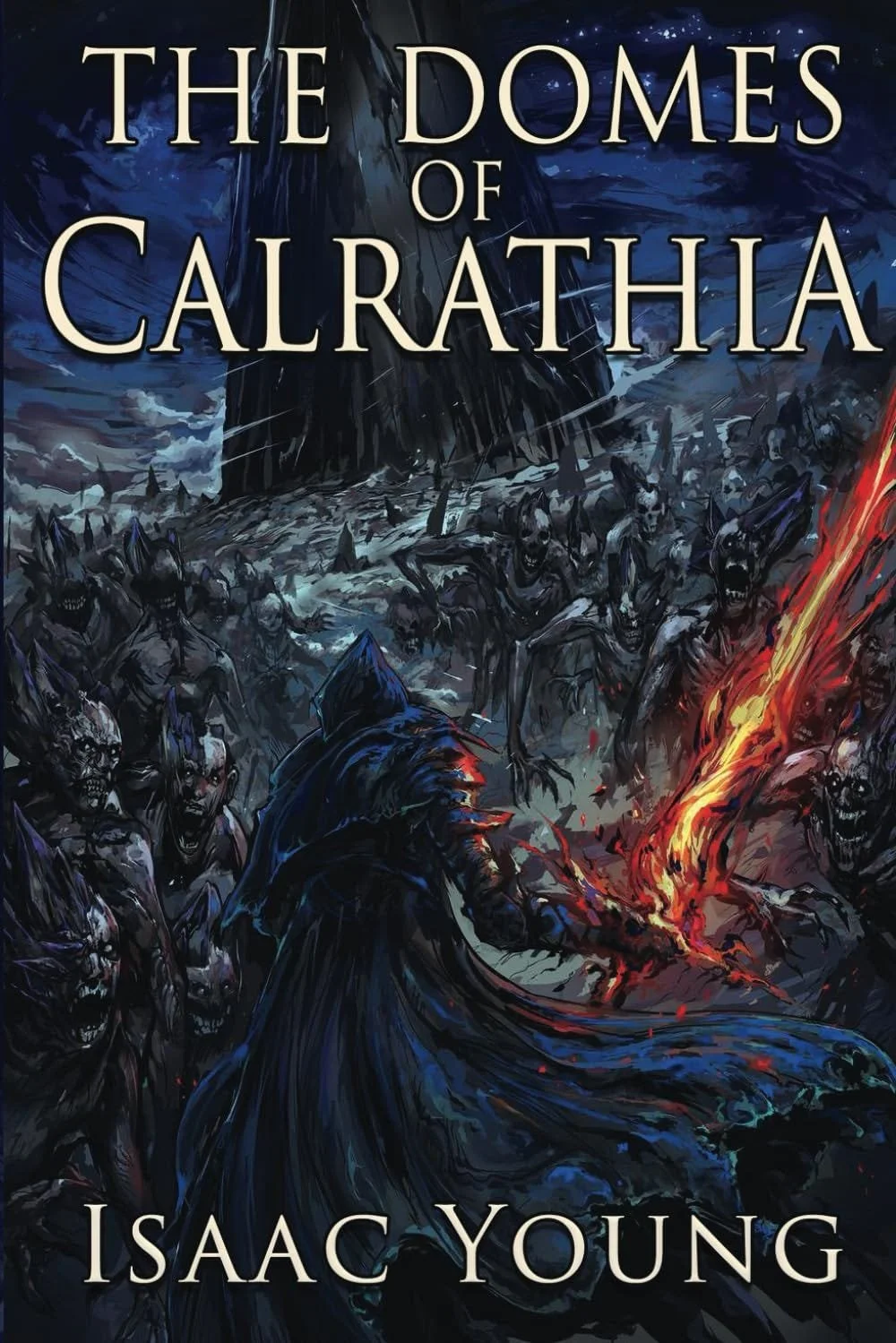
The Domes of Calrathia by Isaac Young is a prime example of the importance of having an eye catching book cover. The above caught my attention when it first released and I’ve been itching to pick up a copy since. Well, I did snap up a copy (thanks Amazon gift card) and I am very glad I did.
This is striking piece of fantasy that immediately announces itself as something thoughtful, atmospheric, and quietly ambitious. Set in an impossibly distant future where civilisation survives in fragments amid vast, hostile wastelands, the novel introduces a world that feels ancient, decayed, and menacing, yet shaped by deep history and ritual rather than spectacle alone.
At the heart of the story is Sirius, a member of the Astronomer’s Guild who is exiled for a crime that remains deliberately opaque. His punishment is to carry a precious book of knowledge across a ruined world to the legendary domes of Calrathia. This task is understood by all to be a death sentence. What makes the opening so compelling is that Sirius accepts it without protest, not because he expects survival, but because the vow itself matters. That sense of duty, constancy, and quiet moral strength defines both the character and the novel as a whole.
Young’s prose is superb throughout. It is measured, confident, and richly textured without becoming overwrought. The world feels dark and threatening not because of constant violence, but because of what is implied. Ruins, half-forgotten technologies, and hostile environments are sketched with restraint, allowing the reader’s imagination to do much of the work. The result is a setting that feels genuinely oppressive and alien, yet believable in its internal logic.
Comparisons to Gene Wolfe are inevitable, and largely fair. There are echoes of The Book of the New Sun in the tone, the layering of history, and the way knowledge itself is treated as something sacred and dangerous. However, The Domes of Calrathia is more accessible and more direct in its storytelling. Where Wolfe often obscures meaning, Young provides clarity without sacrificing depth. Sirius is also a more recognisably heroic figure, guided by a strong moral compass that gives the narrative an almost mythic quality.
The pacing is excellent. Despite its relatively short length, the novel never feels rushed. Sirius is well developed, and his internal struggle carries as much weight as the physical dangers he faces. The story hooked me early and never let go, driven by a steady accumulation of tension rather than sudden twists.
If there is a drawback, it is simply that the book ends too soon. At under 300 pages, this feels very much like the opening movement of a larger work. While the conclusion is satisfying, it also leaves the reader keenly aware that there is far more to explore, both in the world of Calrathia and in Sirius’s journey.
Overall, The Domes of Calrathia is an impressively written and deeply engaging novel. It offers beautiful prose, a fascinating and threatening world, and a central character who lingers in the mind. Book two cannot arrive quickly enough.