Book Review: History' Prime: Renaissance Paradox: 1 by K A Wood
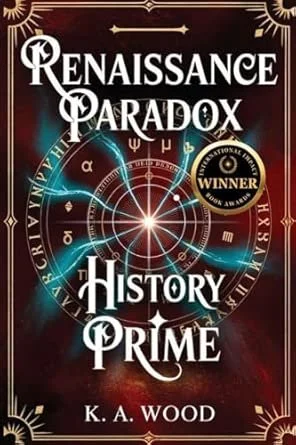
When reviewing self-published work, it is very easy to become hyper-critical and read the book looking for common issues rather than simply enjoying it as a reader. With that in mind, I found I started reading this book with the first mindset rather than the second. I struggled through the first few chapters, picking up every minor flaw with an annoyed huff. However, as I progressed, I found that if you gloss over those minor irritations, this is actually a really thrilling read.
I picked this up to read as part of the IBOR competition (hence my initial critical eye), and it was the blurb that drew my attention to it.
Dr. Glen Larson, a historian at the Museum of Human History, uncovers a 400-year-old textbook. It contains names and dates that raise questions about the history he has studied for years. Was Isaac Newton taught calculus, the laws of gravity, and motion? Have the greatest minds in history been guided by a hidden source of knowledge? And who is behind the effort to suppress it? As Glen digs deeper, he finds himself hunted by a powerful secret society determined to keep humanity stagnant.
There are real Da Vinci Code vibes in this book. It is set entirely in the modern world and features unusual technology, but no evident magic. I wouldn’t class it as fantasy, more a religious or conspiracy thriller. It will appeal to many readers of that genre, but may not satisfy fantasy readers looking for a new world or an interesting magic system.
The story is thrilling, and the concept is well thought out and interesting. I found myself swept along by the characters’ search for clues, the reveals, and the increasing historical references that kept the story grounded in realism and piqued my own interest in the past. There is the right amount of deciphering of clues, investigative adventure, and underlying danger to keep the reader engaged from chapter to chapter. It was these evenly spaced hooks that kept me reading despite some narrative issues I will come to.
There are three main things that challenged me when reading this work. Firstly, repetitive phrasing. Experience has taught me that if you listen to a book being read aloud, issues in sentences and paragraphs stand out more than if you internally vocalise them, and that was the case here. The same word would often be used multiple times in the same sentence or paragraph. If a character interacts with an object, the reader is aware of that the first time it is mentioned and does not need the same adjective repeated constantly to remind us. I think the issue is that the author wanted to describe in great detail the processes the characters were going through and went to excessive lengths to do so, when actually they just needed to trust the reader a little more.
The second issue was the characters. They were all a little too similar. They all had doctorates in different fields, but this wasn’t enough to give them distinct personalities, and they blended together somewhat. They were always agreeing and going along with each other a little too easily. The conversations between them didn’t always feel natural, and this led to the final major issue I had.
Because the characters were all highly knowledgeable, alongside the tech billionaire, they often joined the dots a little too conveniently. It also led to conversations in which they explained the plot in great detail, culminating in large exposition dumps. I understand that the author has created a complex and intriguing story with many historical references that needed to be explained, and these sections were very interesting on the whole. History buffs and readers who enjoy extreme detail and the nuances of a plot will probably lap these sections up eagerly. For me, though, it occasionally felt more like reading a textbook than watching the characters learn organically.
The above issues could and probably should have been picked up by a professional editor, and work on these areas in future instalments will definitely improve the series as a whole. Personally, they took a little of the gloss off what was otherwise a very engaging story. I was reviewing for a competition, so the bar needed to be set fairly high. For most readers, I suspect these issues may not even register, and they will simply enjoy what is ultimately a compelling tale.
Personally, I did enjoy the book. In fact, by the end, I wanted to know what happened next, and from an author’s point of view, that is exactly how you want a reader to feel. So, hats off to K.A. Wood. Yes, my critical head found some pacing and narrative issues, but my reader head loved it. If you enjoy this sort of thriller, then check this out, you probably won’t be disappointed.