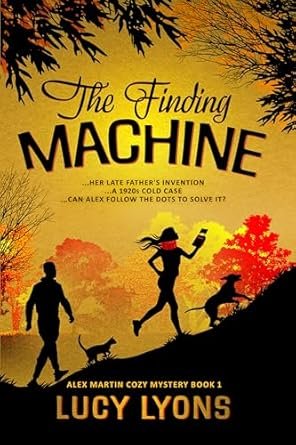
The Finding Machine is one of those stories that will be right up some readers’ streets, yet feel tedious to others. There’s a lot to admire about this novel: an intriguing premise, solid writing, and well-laid clues, but these strengths are mixed with divisive elements that may turn some readers off.
Alex lives in suburban England. She has a steady job, a flatmate, and a fairly comfortable life. One day, she receives a package from her devout mother in Ireland, who has been clearing out the attic and found some of Alex’s late father’s old belongings. Inside the parcel are a few photographs and a small electronic device, a “finding machine” capable of locating any creature, living or dead. This discovery sets Alex on a path to solving a series of mysteries.
As a premise, this is really exciting and original. The idea of a machine that can locate anything, living or dead, opens up huge possibilities: discovering long-lost tombs, tracking ancient relics, or solving historical mysteries. Sadly, the story doesn’t go that way. Instead, Alex uses it to find a cow, a cat, and a dog. To say I was underwhelmed would be an understatement.
Things begin to pick up when Alex starts receiving ominous warnings from psychics, suggesting she’s tampering with forces best left alone. My excitement rose; perhaps the story was turning toward the supernatural? Sadly, it doesn’t. Alex has a brief chat with a local clergyman, dismisses the warnings, and moves on. Ultimately, she uses the machine to resolve a long-standing family mystery, bringing the story to a neat but somewhat predictable conclusion.
The delivery of the mystery itself is competent. The clues are laid out logically and remain engaging, even if the subject matter feels a little mundane for my taste. Pacing, however, is an issue. The story drags at times, and given that it’s set in post-millennial England, it can’t really claim “world-building” as an excuse. Readers who enjoy realism will appreciate the specific British touches; references to brands like Halfords, for instance, but these may date the novel and alienate non-UK audiences.
The prose will likely divide readers. I’ve never been fond of first-person narration, though it can work well when handled deftly (as seen in the works of Alexandra Rob or Rick Riordan). Those authors, however, use past-tense first person, whereas The Finding Machine is written in present-tense first person. Personally, I found it jarring. The grammar and rhythm of that style always felt slightly off to me, not due to poor writing, but simply personal taste.
The Finding Machine boasts a fantastic central concept and competent execution. It will certainly appeal to many readers who enjoy grounded mysteries with a hint of speculative fiction. However, as a science fiction and fantasy work, it falls short. The ideas are too rooted in the ordinary to make this story anything more than a pleasant, if slightly underwhelming, mystery.